12 Kick-off and restart kicks
Principle
Kick-offs are used to start each half of the match or period of extra-time. Restart kicks are used to resume play.
12.1 All kick-offs and restart kicks are drop kicks. Sanction: The non-kicking team has the option of the kick being retaken or a scrum.
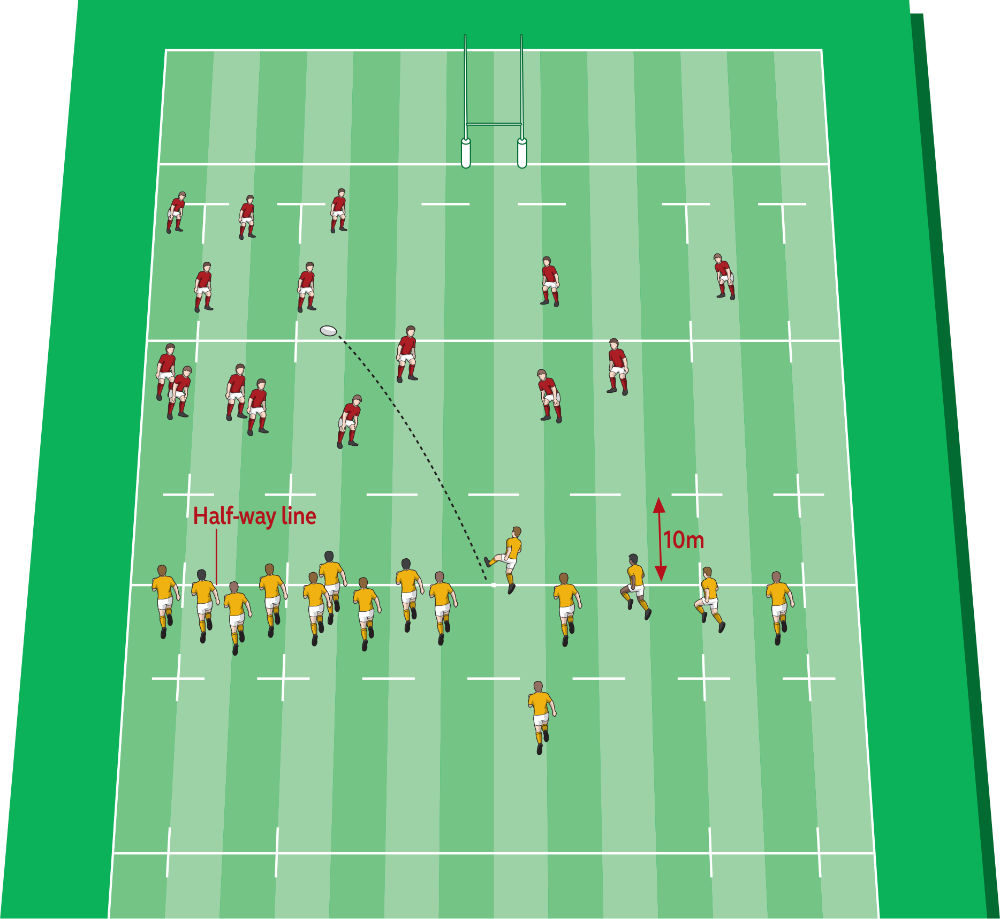
Kick-off
Kick-offs and restart kicks following a score
12.2 Kick-offs are taken on or behind the centre of the half-way line. Sanction: The non-kicking team has the option of the kick being retaken or a scrum.
12.3 The opponents of the team who kicked off the match start the second half.
12.4 After a team has scored, their opponents restart play on or behind the centre of the half-way line. Sanction: The non-kicking team has the option of the kick being retaken or a scrum.
12.5 When the ball is kicked:
a. Team-mates of the kicker must be behind the ball. Sanction: The non-kicking team has the option of the kick being retaken or a scrum.
b. Opposition players must be on or behind the 10-metre line. Sanction: The kick is retaken.
12.6 The ball must reach the 10-metre line. Sanction: The non-kicking team has the option of the kick being retaken or a scrum.
12.7 If the ball reaches the 10-metre line but is then blown back or if an opponent plays the ball before it reaches the 10-metre line, play continues.
12.8 If the ball goes directly into touch, the non-kicking team chooses one of the following:
a. The kick being retaken.
b. Scrum.
c. Lineout.
d. Quick-throw.
12.9 If the ball is kicked into the opponents’ in-goal without touching any player and an opponent grounds the ball without delay or it goes dead through in-goal, the non-kicking team has the option of having the kick retaken or a scrum. If there is a delay, the kick will be deemed accepted, and restarted with a try-line drop out (see 12.12)
12.10 If the ball is kicked into the kicking team’s own in-goal and is made dead by a defending player or it goes dead through in-goal, the non-kicking team is awarded a five-metre scrum.
Other restart kicks (drop-outs)
12.11 Play is restarted with a 22-metre drop-out when:
a.An unsuccessful penalty goal or dropped goal attempt is grounded or made dead in in-goal by the defending team, or the ball goes dead through in-goal from one of these attempts.
b.A team kicks the ball through their opponents’ in-goal from the field of play and it goes dead through in-goal. In this case the defending team can instead choose to have a scrum at the place where the ball was kicked. (see 21.11)
12.12 Play is restarted with a try line drop-out when:
a. The ball is played, kicked in open play, or carried, into in-goal by an attacking player, they fail to score and the ball becomes legally dead inside in-goal, or they carry the ball off the playing area. (see also law 21.11)
b. A kick-off or restart goes into in-goal and a defender does not make the ball dead immediately. (see also 12.9)
c. An attacking player knocks forward in the opponents’ in-goal.
d. The ball is charged down from the field of play by an attacking player and it goes dead through in-goal.
| Type of restart kick | Location of kick | Sanction line |
|---|---|---|
| 22-metre drop out | On or behind the defending team’s 22-metre line. | The 22-metre line. |
| Try line drop-out | On or behind the defending team’s try line. | The five-metre line. |
12.13 A drop-out:
a. Is taken at the location specified in the table. Sanction: Scrum.
b. Must be taken without delay. Sanction: Free-kick.
c. Must cross the sanction line as specified in the table. Sanction: The non-kicking team has the option of the kick being retaken or a scrum.
d. Must not go directly into touch. Sanction: The opposing team chooses one of the following:
- The drop-out being retaken; or
- Scrum on the sanction line in line with where the ball was kicked; or
- A lineout; or
- A quick-throw.
12.14 An opponent must not advance in front of the sanction line before the ball is kicked. Sanction: Free-kick.
12.15 An opponent, who is in front of the sanction line, may not delay or obstruct the drop-out. Sanction: Penalty.
12.16 If the ball crosses the sanction line but is then blown back, play continues.
12.17 If the ball does not cross the sanction line, advantage may apply.
12.18 If a drop-out reaches the opponents’ in-goal without touching any player and an opponent grounds the ball without delay or it goes into touch-in-goal or on or over the dead-ball line, the non-kicking team has the option of having the kick retaken or a scrum. If there is a delay, the kick will be deemed accepted, and restarted with a try-line drop out (see 12.12)
12.19 The team-mates of the kicker must be behind the ball when it is kicked. Those who are in front of the ball when it is kicked may be sanctioned unless they retire and do not interfere with play until they are put onside by the actions of a team-mate. Sanction: Scrum.
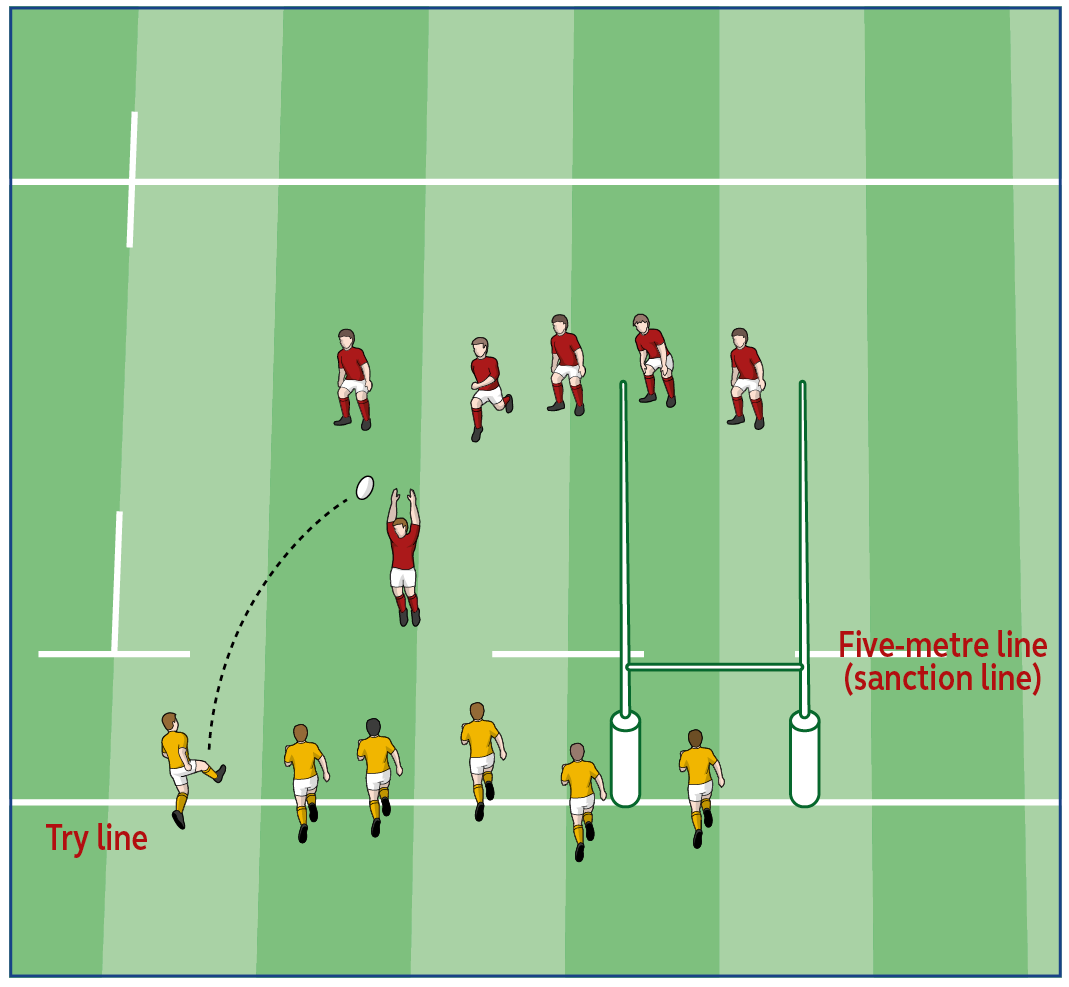
Try line drop-out