Monitoring Progress
Effective monitoring is essential to ensure that Match Officials are progressing toward their fitness goals and are physically prepared for the demands of officiating. By tracking both in-session performance and long-term fitness trends, Officials can optimise their training, prevent overtraining, and maintain peak performance throughout the season. Monitoring also provides valuable feedback for adjusting training loads, identifying areas for improvement, and ensuring readiness for match-day performance.
Within-session monitoring
Within-session monitoring involves tracking key performance indicators during training sessions to ensure that Match Officials are working at the appropriate intensity and maintaining quality throughout the workout. This real-time feedback is essential because it provides insight into both internal and external load, helping Coaches and Match Officials make informed decisions. Monitoring tools such as RPE, heart rate, and GPS can be utilised to determine how taxing a session is on the body, provide objective data on cardiovascular strain, and detail external load to replicate match demands. Together, these metrics allow for adjustments to training loads and ensure that each session meets its intended physiological goals. They also enable comparisons across sessions or phases of the season, supporting long-term performance development and recovery management.
1. Rate of Perceived Exertion (RPE)
What it is:
- A subjective scale (commonly 1–10 or 6–20) is used to rate how hard a Match Official feels they are working during a session.
How it's used:
- Match Officials report their perceived effort immediately after a drill or session.
- Can be used to calculate session training load (RPE × session duration in minutes) to estimate internal training load.
2. Heart Rate Monitoring
What it is:
- Tracking heart rate (HR) in real time using chest straps or wrist-based monitors.
How it's used:
- Monitor HR during intervals to ensure training is within target zones (e.g., 85–93% HRmax for HIIT).
- Assess recovery by observing how quickly HR drops between efforts.
3. GPS (Global Positioning System) Tracking
What it is:
- Using GPS devices to measure total distance, high-speed running, accelerations, and decelerations.
How it's used:
- Track movement patterns during drills or simulated match play.
- Analyse metrics like top speed, sprint count, and distance covered at various intensities.
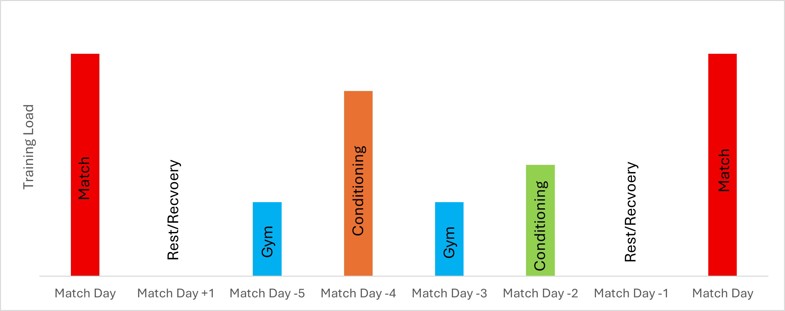
These within-session monitoring techniques can be used to ensure Match Officials are following a load periodisation model that supports optimal performance between games. The graphic below outlines a typical load periodisation that can be utilised during busy match periods to ensure optimal recovery and performance in subsequent matches. This incorporates two conditioning sessions, one high training day four days before the match and one lower training load day two days prior to the match. This ensures Match Officials have adequate time to recover from the previous match while also ensuring fitness levels are maintained to ensure optimal performance for the upcoming match.