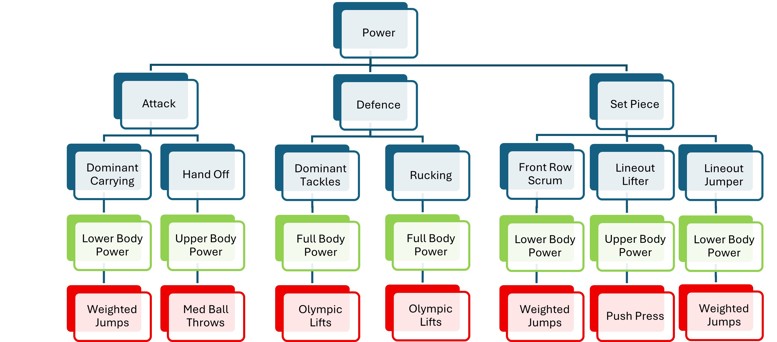
Introduction to Power
Power is a crucial physical quality in rugby union, especially for explosive actions like sprinting, tackling, and jumping. While maximum strength refers to the highest amount of force a player can exert, typically developed through heavy resistance training at low speeds, power is the product of both force and speed and is the ability to produce force quickly. Developing maximum strength provides the foundation for generating higher levels of power, meaning that as a player's strength improves, their potential to produce powerful, game-specific movements also increases.
Benefits of Power for Female Players
The ability to produce force quickly plays a key role in the performance of female players. The power capabilities determine the ability of a player to sprint to score a try, make explosive changes of direction to evade a defender, jump to catch a ball, and explosively tackle an opposition player. Research has shown that the ability to produce high levels of power is a key factor that distinguishes professional athletes from semi-professional athletes, highlighting the increasing importance of power as the level of competition rises (Argus, Gill and Keogh, 2012). Overall, increasing power enhances the ability of female rugby players to perform key rugby skills with greater force and efficiency, which contributes directly to individual and team performance.