Monitoring and Evaluating Fitness Levels
Aerobic fitness can be monitored and evaluated using a number of different methods, such as the Yo-Yo Intermittent Recovery Test, Time Trial or the Bronco. All these tests give an outline of fitness levels, but also can be used to calculate maximal aerobic speed (MAS), which can be used to individualise conditioning sessions.
Yo-Yo Intermittent Recovery (Yo-Yo IR) Test
The Yo-Yo IR test evaluates an individual’s ability to repeatedly perform intermittent exercise (Bangsbo, Iaia and Krustrup, 2008). The Yo-Yo IR Level 2 test is generally used to assess athletes as it taxes both the aerobic and anaerobic energy systems.
The Yo-Yo IR Level 2 test involves the player running a 20m shuttle at increasing speeds, which is dictated by audio beeps. After each shuttle, the player has an active recovery period where they must walk/jog around a 5m recovery cone. The test continues until the player fails to reach the line in time with the beep twice in a row, with the level at which the player fails recorded.

Figure 1. Yo-Yo Intermittent Recovery (Yo-Yo IR) Level 2 Test
Time Trial
Time trials are a practical and effective method of assessing the fitness levels of female players and are generally easy to administer with minimal equipment required. Time trials generally involve players running a set distance (e.g. 1.2km) as fast as possible, with their time recorded. Time trials are typically completed as a continuous run with limited to no changes of direction. For example, to complete a 1.2km time trial, the players would run around a 50m x 50m square five times.
Bronco
The bronco test is a commonly used test in rugby to assess fitness levels. The bronco test consists of five continuous shuttle runs of 20m, 40m and 60m, which equate to 1.2km in total. The player must complete the run as fast as possible, with the time to complete recorded. The bronco test is said to be more game-specific than a 1.2km time trial due to the shuttle run format involving numerous 180-degree changes of direction throughout the test.
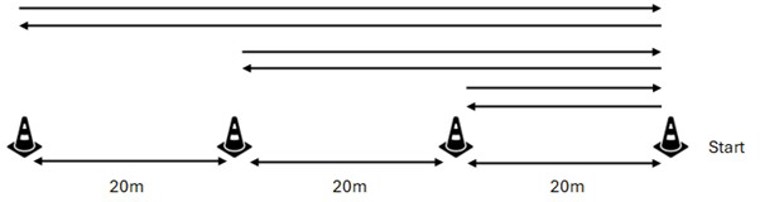
Figure 2. Bronco Test