Monitoring and Evaluating Progress
Linear Speed Monitoring
Linear speed can be assessed and monitored using timing gate systems such as dual-beamed photocells, which are considered the gold standard of linear speed assessment (Haugen and Buchheit, 2016). Timing gates are generally set up in 10m intervals, usually up to 30m, in order to get an overall picture of the player’s acceleration and max velocity ability.
The use of global positioning systems (GPS) can be a useful tool to monitor athletes’ linear speed throughout each session throughout the year. Although GPS is not considered as accurate or reliable as timing-based systems, it can be shown to have acceptable accuracy for sprint speed, especially for devices with higher sampling frequencies, such as 10 Hz (Haugen and Buchheit, 2016). Regular monitoring of athlete sprint speeds is crucial to ensure athletes are getting regular exposures to high speeds relative to their maximum sprint speed. Research has shown that field sport athletes who get regular exposures of >95% of their maximal speeds are at a reduced injury risk, specifically hamstring injuries, compared to players who produce lower relative velocities, with 1-2 exposures of >95% maximal speed each week recommended (Malone et al., 2017). This outlines the importance of exposing female rugby players to 95% of their top speed regularly throughout their training.
Change Of Direction and Agility Assessments
Tests such as the 5-0-5 Agility Test, although called “Agility” tests, are measures of change of direction ability rather than agility, as there is no cognitive or perceptual component to the test.
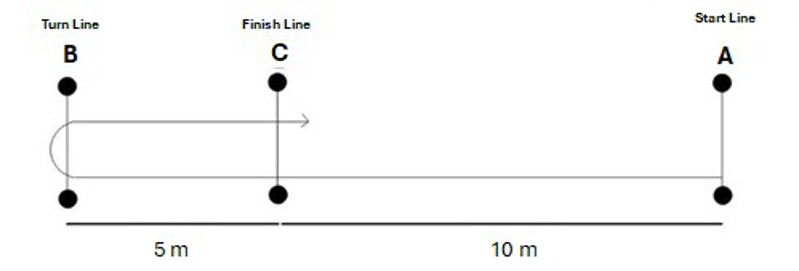
Figure 4. 505 Agility Test
In order to assess an athlete’s agility ability, it is crucial that the athlete has to react to unpredictable stimuli, such as a coach’s signal or a visual light signal (Sheppard and Young, 2006; Nimphius et al., 2018). Although the quantitative measures of the agility test, such as the time taken to complete the test, are important, it is also important to take note of qualitative measures during the test by performing a technical evaluation of the ability of the athlete to change direction efficiently and correctly (Nimphius et al., 2018).
Coaching Tips:
- Agility training needs to closely represent game tasks for players to maximise transfer to the pitch.
- Fundamentals of effective change of direction technique is an important underpinning prior to more complex agility training.