Introduction to Strength and Benefits of Strength Training for Female Players
Rugby is a physically demanding contact sport that requires power, agility and speed, with strength underpinning these key performance indicators. In addition to being the backbone of an athlete’s power, agility and speed capabilities, strength plays a key role in injury prevention, ensuring that athletes are robust enough to be able to tolerate the physical demands of the sport (McGuigan, Wright and Fleck, 2012).
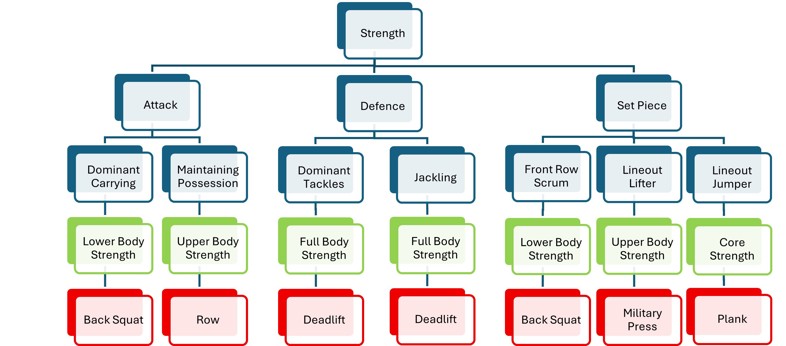
The physical attributes and performance characteristics of female rugby players differ depending on their playing position. Forwards typically exhibit greater lean and fat mass compared to backs, which supports their role in scrummaging, tackling, and maintaining physical dominance in contact situations (Posthumus et al., 2020). In contrast, backs tend to achieve faster sprint times over short distances, such as 10m and 20m, and reach higher peak velocities, reflecting their emphasis on speed and agility in open play (Woodhouse et al., 2022). Research has shown that when comparing strength levels relative to body weight, both forwards and back have similar upper and lower body strength capabilities (Yao et al., 2021; Woodhouse et al., 2022). Overall strength plays a crucial role in all aspects of rugby performance, from attack to defence to set piece.