Postpartum Transition
Transition from pregnancy into postpartum must consider the mode of delivery (vaginal or caesarean section) and the lived experience of the individual. While vaginal delivery is typically considered ‘normal’, it can involve significant tissue trauma, especially if delivery intervention was required e.g., vacuum or forceps assistance. With regards to caesarean section delivery, these can vary from controlled, planned elective procedures to emergency situations involving rush and panic. Considering the degree of trauma involved in an individual’s delivery is important for estimating tissue healing timeframes, e.g. skin abrasion versus grade 1 muscle tear versus grade 3 or 4 full thickness tears etc. Asking an athlete about their delivery experience offers them the opportunity to express any traumatic experience or concerns and can highlight if someone needs referral for ongoing support e.g., a birth debrief at their delivery centre or signposting to the GP for psychological referral.
The incidence of postpartum depression and anxiety is approximately 12% and 13% respectively (NICE, 2025). Useful screening tools include the Edinburgh Postnatal Depression Scale (Gollan et al., 2021) or the Clinician Administered Post-Traumatic Stress Disorder Scale (de Graaff et al., 2018).
As the body adjusts to postpartum, the individual will experience widespread physical, physiological and psychological changes (Donnelly et al., 2022a). These include body mass changes as the body expels waste products from pregnancy, and the uterus reduces down to size. Breast fluctuations occur as breast milk is produced, and these will continue if someone is breastfeeding. This population is potentially at risk of energy deficiency if an individual is not fuelling enough compared to the energy they are expending. Postpartum women are often sleep deprived, grazing, breastfeeding and putting the needs of others first. Professionals should be aware to consider energy balance when supporting this population. Figure 1 below demonstrates the widespread bodily considerations when supporting postpartum women (Donnelly et al., 2022a). While focused on supporting returning to running, the principles can be applied to any type of activity or sport.
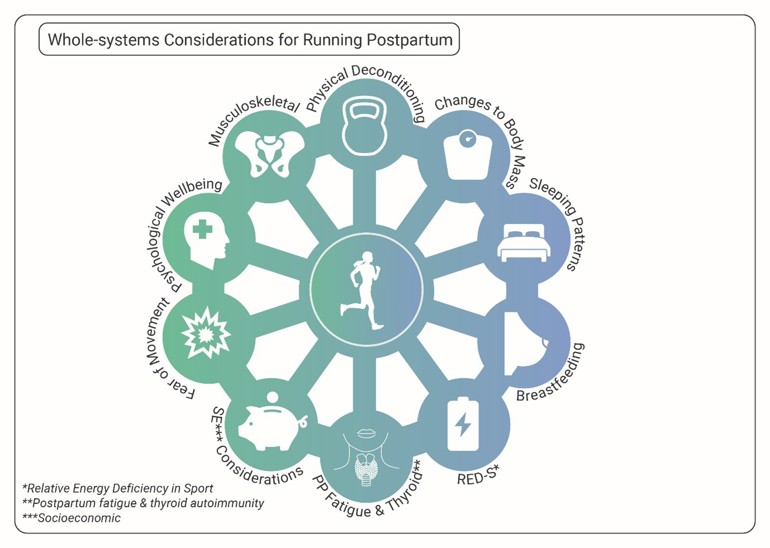 Figure 1
There is no one-size-fits-all timeline or criteria for someone returning to physical activity and sport postpartum. Individual history, baseline and pregnancy and birth experience will influence readiness for progressing physical activity (Davenport et al., 2025). Expert consensus supports a gradual return with incremental progressions. For example, the infographic below, Figure 2, illustrates a suggested progression of activity to support postpartum individuals return to rugby and encompasses focused pelvic floor training, progressing to gradual exposure to resistance training and impact activities such as running and jumping, before gradual exposure to rugby activities.
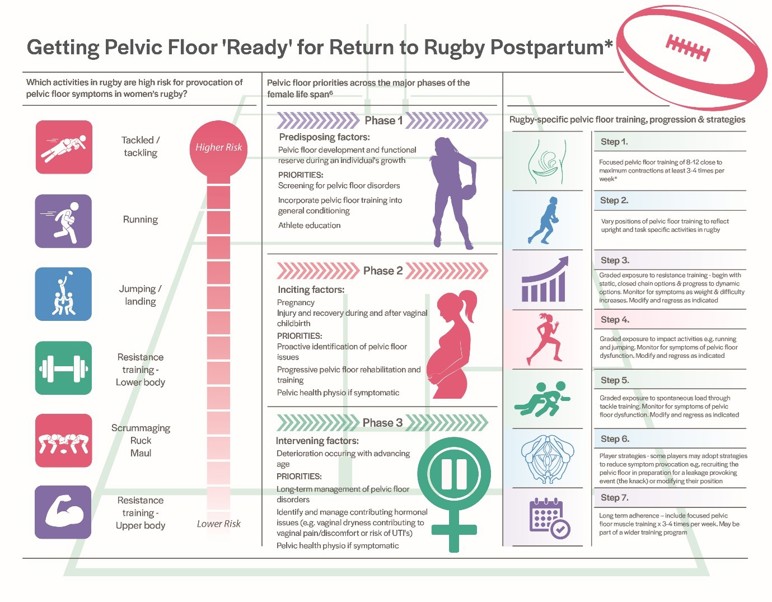 Figure 2
A two-part Delphi study on returning to running postpartum (Christopher et al., 2023, Deering et al., 2024) identified that health and exercise professional consensus for assessing someone’s readiness for impact testing postpartum involves a series of load and impact tests first proposed by Goom et al., (2019):
- Walking 30 minutes
- Single leg balance 10 seconds
- Single leg squat 10 reps each side
- Jog on the spot 1 minute
- Forward bounds 10 reps
- Hop in place 10 reps each leg.
Postpartum individuals should ideally be able to complete this symptom-free, i.e. present no pain or symptoms of Pelvic Floor Dysfunction. Provocation of symptoms identifies reduced load capacity and the need for focused strength and conditioning. Tools such as the PFD-SENTINEL can be used to screen for symptoms during load and impact testing (Giagio et al., 2023).
Identification of symptoms indicates the need to provide information of pelvic floor muscle training and information about pelvic health physiotherapy to guide rehabilitation.
A useful tool for indicating a postpartum individual's readiness for exercise engagement is the Get Active for Postpartum tool (CSEP, 2025b).
Get Active for Postpartum tool (CSEP)
When it comes to return to sport decision making, progression and readiness will depend on both the individual and the specific sport demands (Kennaway, 2026). For example, Rugby will require the ability of an athlete to manage the load demands depending on player position, and also require safety considerations and training to reengage in contact and scrum tasks (Donnelly et al., 2024). A framework that is useful to guide return to sport postpartum decision making and considers female-specific nuances is the 6 Rs framework (Donnelly et al., 2022b). See figure 3 below:
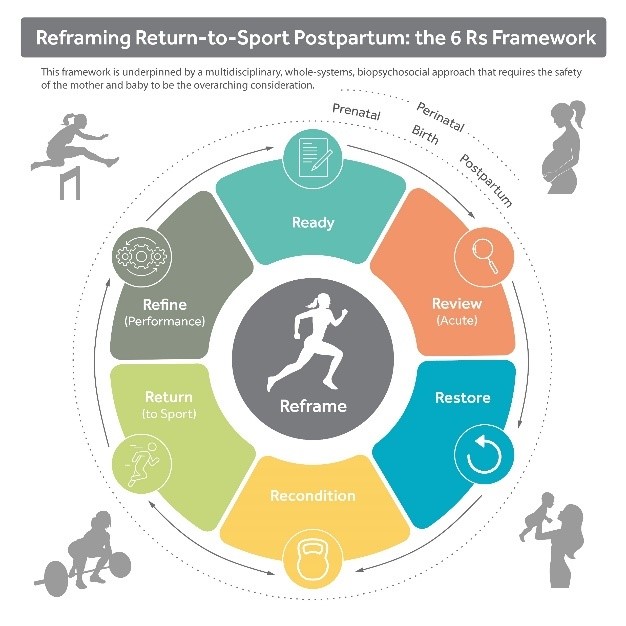
Figure 3
A useful two part podcast applying the six Rs framework was released by BJSM in 2023:
- https://bjsmbmj.podbean.com/e/be-the-difference-that-makes-the-difference-for-pregnant-and-post-partum-women-ep-497/
- https://podcasts.apple.com/si/podcast/bringing-the-6rs-to-life-a-patient-perspective/id330966919?i=1000552212832
Other useful podcasts include:
- https://podcasts.apple.com/gb/podcast/why-did-no-one-tell-me-the-female-athlete-edition/id1530617581?i=1000590514615
- https://podcasts.apple.com/gb/podcast/transitioning-from-athlete-to-mother-athlete-with-usa/id1530617581?i=1000587592306